REEF CHEMISTRY · GUIDE
How to switch from 2-part to powdered reef chemistry.
A practical guide for reefers running BRS Pharma, ESV B-Ionic, Tropic Marin Original Balling, or similar systems. Real numbers, cited sources, no hype.
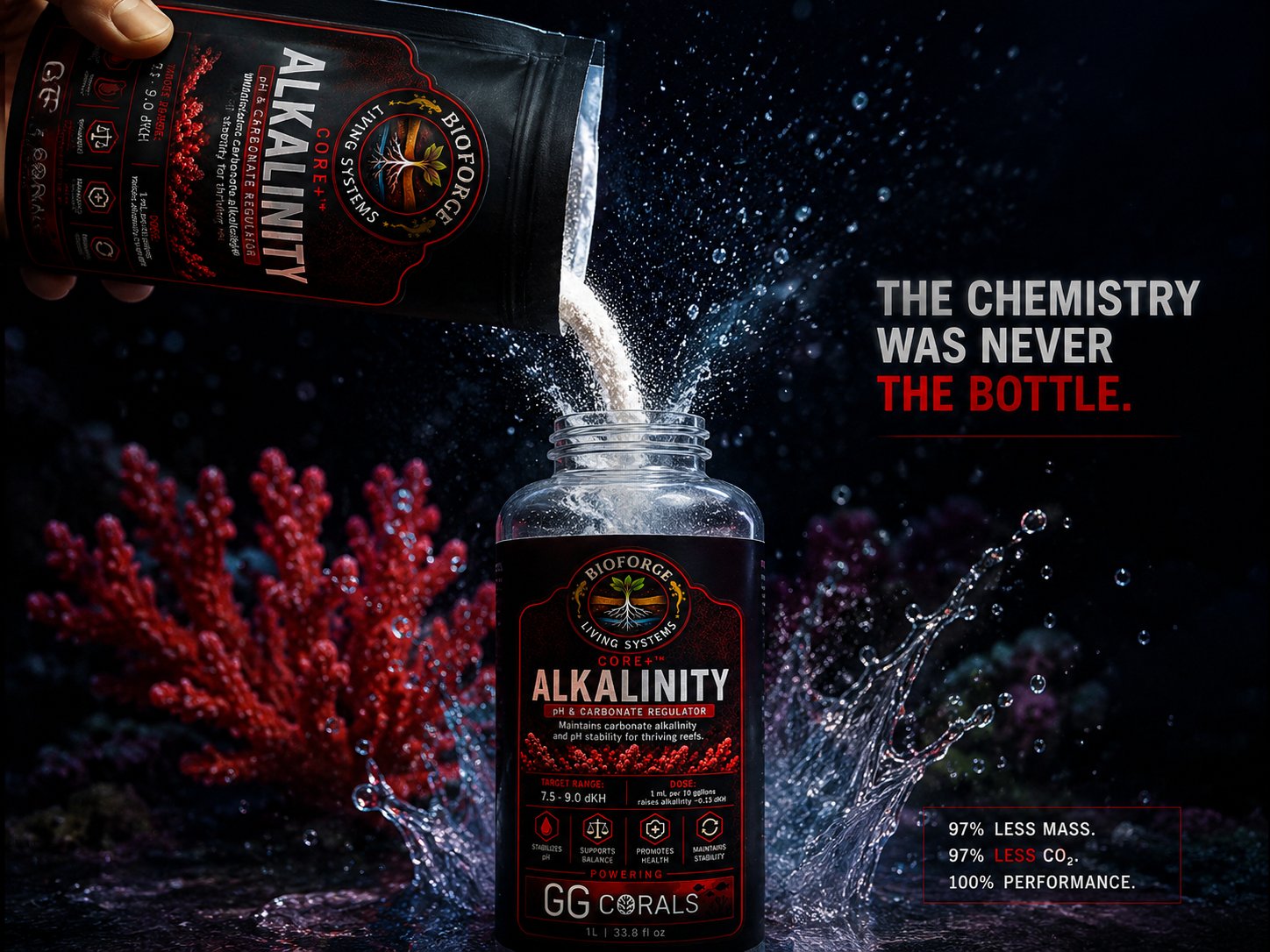
If you've been dosing reef chemistry for a while, you already know the fundamentals: keep alkalinity stable, replace what your corals consume, don't change too many variables at once. Switching from liquid 2-part to powdered chemistry doesn't change any of that.
What changes is the format. Powdered systems ship as dry salt, you mix it with RO/DI water, and you dose the resulting stock solution. The reef itself doesn't care whether your alkalinity arrived dissolved or dry — it only responds to concentration, stability, and consistency.
This guide explains how to make the switch without destabilizing your tank. The first half is the practical stuff most reefers need. The second half goes deeper into the chemistry for anyone who wants to verify the math themselves.
The three things you need to know
- Don't change two things at once. When you switch systems, hold your alkalinity target, calcium target, nutrient strategy, and water change schedule constant. One variable at a time. This is the single most important rule.
- Expect your daily mL to change. Different products deliver different amounts of alkalinity per mL. Your old dose isn't your new dose. The conversion math is straightforward, and we've built a calculator that handles it.
- Test daily during the transition. For a week or so after switching, test alkalinity every day. Watch the trendline, not the hourly fluctuations.
That's the practical core. Everything else in this article is supporting detail. If you're just here to switch, you can skip to the transition protocol below.
What BRS, ESV, and Tropic Marin already do well
Before getting into how BioForge is different, it's worth being honest about what the established systems do well. They've been used successfully on tens of thousands of reef tanks. They work.
BRS Pharma 2-Part
BRS Pharma Soda Ash and Calcium Chloride made 2-part dosing accessible to most of the hobby. The system is simple to mix, predictable in concentration, and so widely adopted that troubleshooting help is a forum search away.
ESV B-Ionic
ESV B-Ionic is one of the cleaner turnkey liquid systems on the market. Balanced formulation, long manufacturing track record, and a quiet reputation for stability. Many successful SPS tanks have run B-Ionic for years.
Tropic Marin Original Balling
Tropic Marin Original Balling takes a chemistry-first approach focused on ionic balance and long-term equilibrium. It appeals strongly to reefers who think about chloride accumulation, sodium drift, and the long game.
None of these are bad systems. The decision to switch should be based on what you actually want to change about your workflow — not on the assumption that the established options are flawed.
Why reefers consider switching to powdered chemistry
Three things tend to drive the decision:
Shipping mass
A gallon of liquid reef chemistry is mostly water. The actual active chemistry is a few hundred grams of dissolved salt. The rest is shipping weight. For reefers dosing heavily — especially SPS-dominant tanks — this becomes meaningful quickly. Powdered chemistry eliminates the water from the supply chain. You add it back at home with RO/DI you're already producing.
Storage footprint
A reefer running alkalinity, calcium, magnesium, and kalkwasser easily accumulates 4-6 gallons of liquid inventory at any given time. Dry chemistry compresses that into a small shelf. For apartment reefers, fish-room operators, or anyone working in a cabinet-limited setup, that matters more than marketing usually acknowledges.
Batch documentation
Most reef brands describe their manufacturing in general terms. A smaller number publicly archive the independent ICP-OES verification for each production batch. That distinction matters to reefers who think in terms of operational documentation rather than brand reputation. Documented chemistry behaves differently from assumed chemistry, especially when something goes wrong and you want to trace what changed.
The transition protocol
For most tanks, especially anything with stony corals, switch gradually over ten days. The point is to give your tank time to adjust to any subtle concentration differences without producing a swing.
Test alkalinity daily through the transition. If you see a drift of more than 0.5 dKH, slow down — hold the current ratio for an extra day or two before moving to the next step. Acropora-heavy systems especially benefit from a slower curve.
This is particularly important for SPS-dominant tanks running ultra-low nutrient systems, where corals have been documented to be sensitive to alkalinity changes — Randy Holmes-Farley has noted that such tanks are often better served by alkalinity in the 7-8 dKH range with minimal variation.1
The actual conversion math
This is the part where most reef brands wave their hands. Here's the real math, using BioForge's published concentration and the manufacturer-published concentrations for the systems you might be switching from.
Each system has a different alkalinity delivery rate — how many dKH it raises per mL added per 10 US gallons of tank water. That number, which we call the P value, is the only way to compare systems fairly. Daily mL volumes alone are meaningless because they don't account for concentration.
| System | Delivery rate (dKH/mL/10 gal) | Vs BioForge | Source |
|---|---|---|---|
| BioForge Core+ ALK | 0.134 | — | V5.9 formulation |
| BRS Pharma Soda Ash | 0.140 | +4.5% stronger | BRS official |
| Tropic Marin Balling Part B | 0.073 | −45% weaker | TM official |
| Brightwell Reef Code B | 0.222 | +66% stronger | Calculator methodology |
| Brightwell Alkalin8.3 | 0.310 | +131% stronger | Calculator methodology |
| ATI Essentials Mixed Reef #1 | 0.264 | +97% stronger | Calculator methodology |
| ESV B-Ionic | not published | use dKH/day mode | — |
Higher delivery rate means less daily volume needed. Lower delivery rate means more daily volume. Neither is inherently better — see the chemistry section for the trade-offs.
Switching from BRS Pharma Soda Ash
BRS publishes a clear example: their official Soda Ash dosing instructions show that 107.1 mL of mixed solution restores 1.5 dKH on a 100 US gallon tank. That works out to a delivery rate of approximately 0.140 dKH per mL per 10 US gallons.6
BioForge Core+ ALK, derived from our V5.9 formulation (sodium carbonate, sodium sulfate, potassium bicarbonate, and borax dissolved into 1 L of RO/DI), delivers approximately 0.134 dKH per mL per 10 US gallons.8
These are nearly identical. In practical terms, if you're currently dosing 85 mL/day of BRS Soda Ash on a 120-gallon tank, your equivalent BioForge dose is approximately 89 mL/day. Less than 5% difference. Your existing dosing pump calibration will barely need adjustment.
Show the math
Step 1. Calculate dKH delivered per day by your current BRS dose.
(85 mL/day) × (0.140 dKH/mL/10 gal) × (10 gal / 120 gal) = 0.99 dKH/day delivered
Step 2. Calculate BioForge mL needed to deliver the same 0.99 dKH/day.
(0.99 dKH/day) ÷ (0.134 dKH/mL/10 gal × 10 gal / 120 gal) = 88.7 mL/day ≈ 89 mL/day
Most dosing pumps won't notice a 4 mL/day difference. You can leave your schedule alone and adjust after a week of testing.
Switching from Tropic Marin Original Balling
Tropic Marin publishes their official figure on the Original Balling product information page: 30 mL of Part B raises alkalinity by 2.2 dKH in 10 US gallons of tank water. That works out to 0.073 dKH per mL per 10 US gallons.7
BioForge Core+ ALK delivers nearly twice as much alkalinity per mL. If you're currently dosing 80 mL/day of Tropic Marin Part B, your equivalent BioForge dose is approximately 44 mL/day. Your daily volume drops significantly. Most reefers in this position find their dosing pump runtimes shorten meaningfully.
Switching from ESV B-Ionic
ESV does not publish a direct mL-to-dKH conversion factor for B-Ionic, which makes mathematical conversion difficult. The practical workaround: use your tank's measured daily alkalinity consumption (in dKH/day) and use the BioForge calculator in tank-consumption mode. Enter your dKH/day demand directly, and the calculator returns your BioForge dose.
For most ESV users, BioForge Core+ ALK delivers similar alkalinity per mL — within roughly 10-20% — but we can't promise an exact factor without a published number from ESV.
What makes BioForge different from a pure soda-ash 2-part
BioForge Core+ ALK isn't just dissolved sodium carbonate. The V5.9 formulation includes sodium sulfate, potassium bicarbonate, and borax. The reason isn't alkalinity delivery — sodium carbonate alone handles that. It's about what happens between water changes.
A pure 2-part system adds sodium and chloride with every dose. Water changes remove that accumulation. Skip a few water changes, and pure-2-part users see ionic drift compound — salinity creeps up, sodium-to-chloride ratios diverge from natural seawater, and the tank starts asking for corrections.23
BioForge's Balling-adjacent formulation slows that drift. The added components (sodium sulfate, potassium bicarbonate, borax) are designed to maintain ionic ratios closer to NSW — the same reasoning that drives experienced reefers toward three-part Balling systems, in a simpler dry-to-mix format.
We still recommend regular water changes. The chemistry is designed to forgive a missed change — not replace one.
PRACTICAL TOOL
Skip the math entirely.
The BioForge calculator handles all of this automatically. Pick your current system, enter your dose, and get your BioForge equivalent.
Open the calculator →Best practices for avoiding precipitation
Precipitation — visible cloudiness or crystalline buildup in your dosing line or near the dosing point — happens when calcium and carbonate meet at high local concentrations before they have time to dilute into the tank.5 This is true of all 2-part systems, liquid or powdered.
The risk depends on concentration, dosing location, tank pH, and mixing quality — not the format of the chemistry itself.4 To minimize the risk:
- Dose into high-flow areas — return pump outflow, near a powerhead. Avoid stagnant chambers in the sump.
- Separate alkalinity and calcium dosing timing — at minimum a few minutes apart, ideally an hour. Never dose both into the same flow path simultaneously.
- Fully dissolve powders before use — this sounds obvious, but incomplete dissolution creates unpredictable per-mL chemistry. Mix until clear, with no visible particulate.
- Don't over-concentrate — there's no trophy for the highest concentration. Over-concentrated stock increases precipitation risk, amplifies pump calibration errors, and makes small dosing mistakes proportionally worse.
The four mistakes reefers make when switching
Most switching problems aren't chemistry problems. They're operational problems. Watch for these four, in roughly the order they tend to bite:
Changing more than one variable at once
The most common, most preventable mistake. Reefers switch chemistry brands at the same time they bump alkalinity target, adjust nutrient strategy, or change salt mix. When something drifts, there's no way to identify which change caused it. Switch only the chemistry. Keep everything else fixed for at least two weeks.
Matching daily mL instead of delivered dKH
Reefers copy their old mL volume into the new system because the number feels familiar. If the new system is twice as concentrated, you've just doubled your alkalinity intake overnight. Run the math or use the calculator. The right comparison is dKH delivered per day, not mL/day.
Skipping the gradual transition on SPS tanks
Acropora and other SPS corals don't punish you for switching brands — they punish you for switching brands abruptly. Even a 0.5 dKH swing over 24 hours can cause tip-burning or stress events. The ten-day overlap protocol exists specifically to prevent this. SPS-heavy systems especially benefit from a slower curve.
Not testing through the transition
Switching is the one time you actually need daily alkalinity tests, even if you normally test weekly. The goal isn't to chase numbers — it's to catch drift early. A 0.2 dKH drift on day 3 caught and corrected is nothing. The same drift unnoticed for ten days is a stress event. One week of daily testing prevents months of recovery.
Everything above is enough for most reefers to make the switch successfully. If you want to understand the underlying chemistry — why these numbers work, why ionic balance matters, why batch verification is more than marketing — keep reading. Otherwise, head to the FAQ or run your numbers through the calculator.
The chemistry, for those who want it
Why daily mL isn't a valid comparison metric
New reefers often compare dosing systems by looking at daily mL: "System A needs 150 mL/day, System B only needs 60 mL/day, so B must be stronger." That's a misleading comparison.
What actually matters is how much alkalinity each mL delivers. A more concentrated system requires less daily volume to deliver the same dKH. A more dilute system requires more. Neither is inherently better. The relevant metric is dKH delivered per mL per unit of tank volume — what we publish on our calculator methodology as the P value.
Higher concentrations have advantages (less daily volume, less storage) and trade-offs (greater sensitivity to pump miscalibration, higher local precipitation risk at the dose point). Lower concentrations are the opposite. Neither is right for every reefer. What matters is knowing which you're using and why.
Ionic balance and the Balling concern
Reefers running Tropic Marin Balling or similar three-part systems often worry about sodium and chloride accumulation from long-term 2-part dosing — Randy Holmes-Farley has written extensively on this. The concern is legitimate: every dose of soda ash adds sodium, and every dose of calcium chloride adds chloride. Without water changes, those ions accumulate.
The mitigation isn't to abandon 2-part dosing. It's to:
- Maintain regular water changes — even modest ones (5-10% biweekly) substantially limit accumulation
- Test salinity over time — if it drifts upward, you're seeing accumulation in real numbers
- Consider Balling-style three-part dosing if you specifically want to avoid accumulation entirely
BioForge Core+ ALK uses sodium carbonate as the primary alkalinity source, like most 2-part systems. The accumulation behavior is similar. We're not solving that problem — we're being honest about it.
Why batch verification matters more than branding
As reef systems become more sophisticated — automated dosers, ICP-monitored chemistry, valuable coral collections — the chemistry itself becomes infrastructure. At that point, the questions reefers ask about their supplements start sounding less like consumer questions and more like industrial process questions:
- Which production batch is this?
- Was it independently verified?
- Can I reference the archived chemistry data?
- Is there lot-level documentation showing batch-to-batch consistency?
Most reef brands cannot answer these questions. A few can. Our position is that the answers should be public — not because every reefer will check, but because the practice of publishing them forces the discipline of producing them.
FAQ
Is powdered reef chemistry chemically different from liquid 2-part?
No. Most reef chemistry systems — powdered or liquid — deliver the same core ions: carbonate, bicarbonate, calcium, and magnesium. The primary difference is delivery format and concentration handling, not chemistry.
Will my daily dose volume change when switching to BioForge?
It depends on what you're switching from. From BRS Pharma, your dose will barely change (within 5%). From Tropic Marin Original Balling, your daily volume will drop by roughly half. The calculator handles the conversion automatically.
Is switching reef chemistry dangerous for SPS tanks?
Abrupt switching can destabilize alkalinity, which SPS corals are sensitive to. The risk drops substantially if you transition gradually over ten days, test daily, and don't change other variables simultaneously. Follow the protocol above.
Can I use my existing dosing pumps?
Yes. Once you mix the powder into stock solution, the resulting liquid behaves like any other 2-part liquid. Your existing pumps, tubing, and check valves all work normally. You'll likely need to recalibrate the daily dose volume based on the new concentration.
What if I just want to try it without committing?
The BioForge Core+ Starter Kit is one month of chemistry, plus the reusable bottles and mixing beaker. $69, free shipping. Most reefers know within a couple of weeks whether the workflow change is worth it for their setup.
Sources & further reading
Every factual claim in this article is sourced from manufacturer-published documentation, peer-reviewed reef chemistry articles, or our own published formulation. If you want to verify anything yourself, here are the primary references:
READY TO SWITCH?
Run your numbers. See what changes.
Open the calculator, enter your current dosing, and see exactly what your switch looks like. No email required.