REEF SCIENCE · EXPLAINER
Why identical ICP results can mean two different tanks.
ICP testing shows you the chemistry with real precision. It has no way to show you the biology sitting on top of it, and that gap is where most dosing confusion actually comes from.
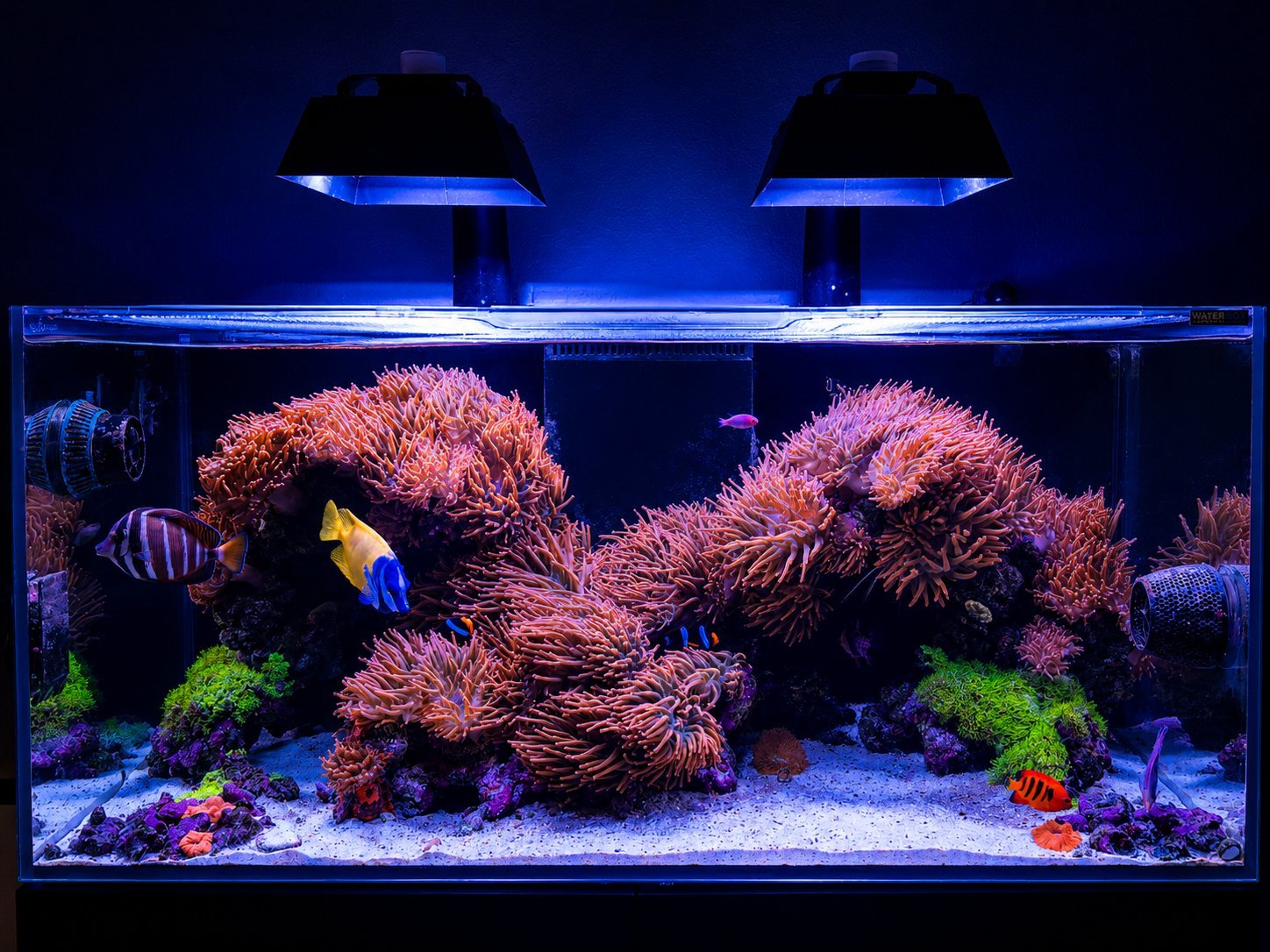
Every reefer eventually runs into the same confusing moment. Two ICP reports come back with alkalinity, calcium, and magnesium within a hair of each other, and yet the two tanks behave nothing alike. One holds steady on a set and forget dose. The other burns through alkalinity twice as fast, and nobody can quite say why.
The honest answer is that the lab report was never going to tell the whole story. ICP-OES testing measures chemistry with genuine precision. It has no mechanism for measuring the living biomass sitting in your display, and that biomass, not the water column alone, is what actually drives day to day demand.
This isn't a knock on ICP testing. It's a reminder of what the tool is built to do, and what it was never built to do.
The three things worth understanding
- An ICP report measures total chemistry, not biological demand. It's a precise snapshot of your water column at the moment the sample left your tank. It doesn't know what's living on your rock.
- Coral biomass and species mix change consumption more than the water column does. Two tanks with the same target parameters can have very different growth rates, organic acid output, and trace element uptake depending on what's actually growing in them.
- Precision testing narrows the guesswork. It doesn't remove the need to watch your tank. A good dosing plan is a confident starting point built from real data, not a fixed answer that runs forever unmonitored.
What an ICP report actually measures, and where it stops
ICP-OES (inductively coupled plasma optical emission spectrometry) works by vaporizing a water sample into plasma and reading the light each element emits. It's an excellent way to catch problems invisible to hobby test kits: heavy metal contamination, ionic drift, and trace elements running low long before a visible symptom shows up.
It also has real, well documented limits.
Total concentration isn't the same as bioavailable concentration
Some elements exist in multiple chemical forms, and only one form is actually usable by corals. Iodine is the clearest example: it exists as iodide, iodate, and elemental iodine, but only the active elemental form is biologically meaningful.12 A report showing high total iodine can still reflect a normal, healthy amount of the form corals actually use, and the reverse is also true. The same split exists for elements like tin, where only the organic form matters biologically.1 Two reefers can post nearly identical total readings and see opposite results in their tanks.
Calibration and algorithms vary between labs
ICP machines are calibrated against a reference matrix, and different labs calibrate for freshwater, seawater, or reef tank water specifically, each producing small variations in the output.4 Interpreting some elements also requires running raw readings through a lab-specific algorithm.3 None of this makes the test unreliable, but it does mean a report is an estimate with a margin, not an absolute truth handed down from a machine.
Why coral biomass changes the math
Corals aren't passive. They constantly release mucus loaded with nutrients, they calcify at wildly different rates depending on species, and they pull trace elements out of the water column at different rates depending on what they are. None of that shows up on a chemistry report, but all of it shows up in your dosing demand.
Organic output varies by season, time of day, and species
Reef corals release dissolved and particulate organic carbon continuously as mucus, and that release rate is not constant. Field studies on Acropora have measured daily organic carbon release roughly five times higher in summer than in winter, and higher during the day than at night.8 Coral mucus itself is also nutrient-dense: phosphate concentrations in mucus have been measured well over a hundred times higher than in the surrounding seawater.9 A tank with a heavier, faster growing coral load is exporting and cycling nutrients at a different rate than a lightly stocked tank running the exact same target parameters.
Reef-scale research backs this up directly: the share of total carbonate chemistry change driven by organic carbon processes, as opposed to calcification alone, has been measured anywhere from roughly a third to nearly ninety percent depending on the specific reef and its community composition.10 Aquariums are smaller and more variable than open reefs, but the underlying principle holds.7 Biological composition, not just target numbers, drives a meaningful share of the chemistry.
Growth rate and calcification differ by species, sometimes by a lot
A tank dominated by fast-calcifying Acropora is pulling alkalinity and calcium out of solution at a very different rate than a tank of the same size running mostly soft corals. Branching stony corals have been documented growing at meaningfully different rates even within the same species across different reef sites,11 and soft corals like pulsing Xenia can double in size in a matter of months under good conditions, a completely different growth curve than a slow-building Montipora colony. Stock two tanks with different mixes of those corals, dial in the same target alkalinity, and you'll see different real world consumption within weeks.
Trace element uptake tracks livestock, not just target numbers
Iodine is a good example on the trace element side too. Tanks dominated by soft corals, anemones, and other invertebrates tend to consume iodine faster than SPS-dominant systems, and a refugium running macroalgae adds its own draw on manganese and iron.5 A heavily stocked tank depletes trace elements faster than a lightly stocked one running an identical supplementation schedule.6 None of this is visible from the target parameters alone. It only shows up once you know what's actually living in the tank.
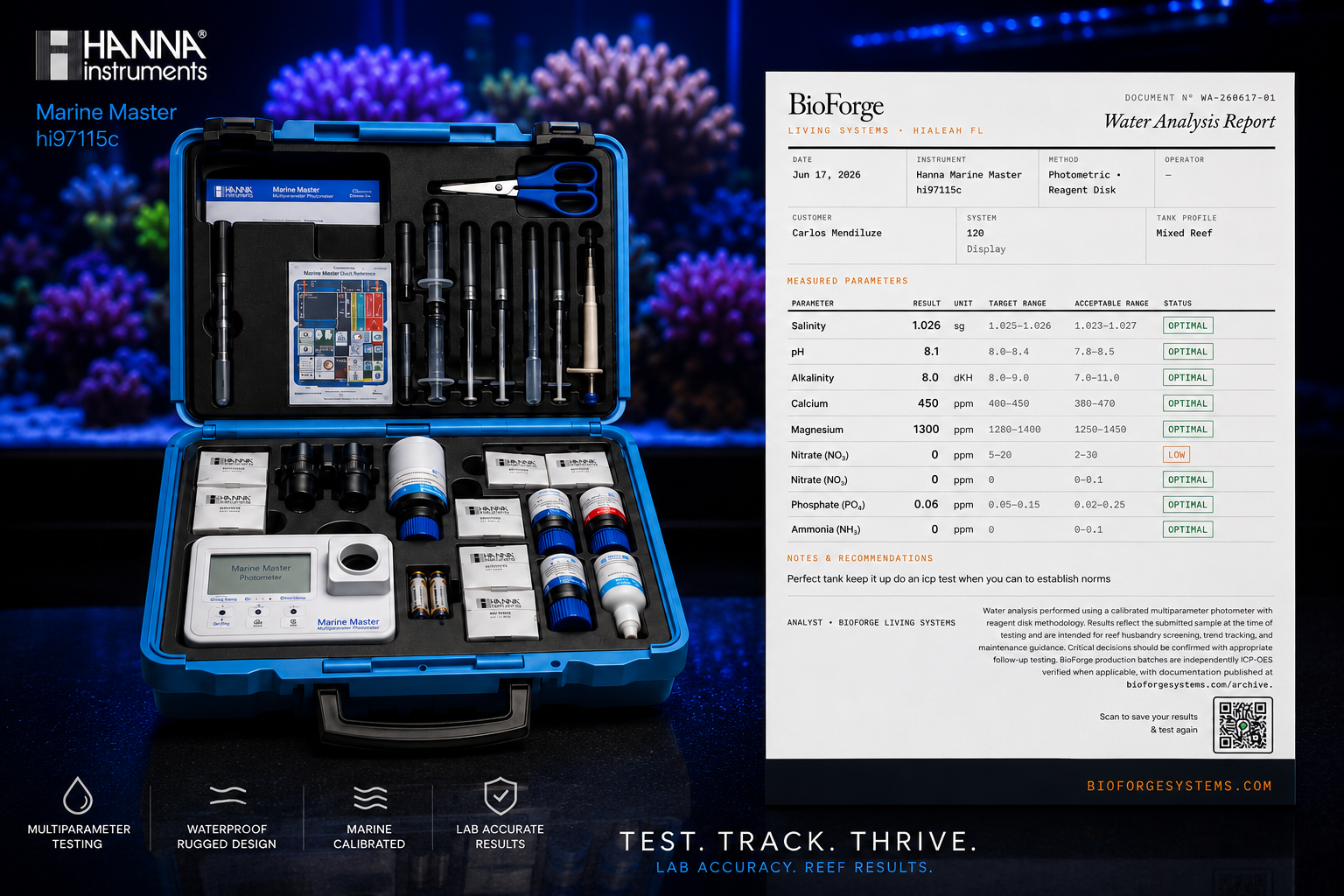
A report like this is genuinely precise about the water on the day it was tested. It has no way to know what's calcifying on your rockwork, which is exactly why the same report can point to different outcomes in two different tanks.
The practice that actually works: dose, then observe and recalibrate
This is standard practice among reef professionals who manage tanks for a living, and it's a simple idea once it's stated plainly: dose based on what your data says your tank needs, then treat that plan as a starting point rather than a permanent setting. Watch the tank as closely as you watch the numbers, and adjust as the tank changes.
In practice that looks like three habits:
- Start from real data. Build the initial dosing plan from your ICP results, tank size, and livestock, not a generic target pulled from a forum thread.
- Retest on a schedule. Thirty days is a reasonable default for a full retest, with a quick alkalinity check weekly in between to catch drift early.
- Watch the tank between tests. Growth, coloration, polyp extension, and behavior all move before a retest will catch a problem. If something looks off, don't wait for the calendar. Retest and adjust.
| Signal | What it can tell you | What to do |
|---|---|---|
| Growth rate | Faster or slower tissue and skeletal growth than expected | Compare against your last retest interval, consider testing early if growth stalls or spikes |
| Coloration | Paling or browning out can flag trace element or nutrient shifts | Cross check iodine, iron, and manganese on your next ICP |
| Polyp extension & behavior | Reduced extension or retraction can flag a chemistry or flow issue | Check alkalinity and calcium with a hobby kit before waiting on a full retest |
| Water clarity & skimmate | Sudden changes can reflect a shift in organic export | Note the change and watch for a corresponding parameter shift at next test |
None of this replaces testing. It's the layer that sits between tests, and it's often the first place a real change shows up.
Why the loudest opinions online don't fit every tank
Reef forums and social media are genuinely useful, and also genuinely skewed. The tanks with the most unusual chemistry are often the ones generating the most dramatic before-and-after posts, and unusual results tend to produce the loudest, most confident opinions about what caused them. That's a normal feature of any large hobby community, not a flaw specific to reefkeeping.
The practical takeaway isn't to ignore community knowledge. It's to treat any single anecdote, including a convincing one, as a hypothesis to test against your own tank's data rather than a rule to adopt outright. Experienced reefers consistently point out that stable, consistent parameters matter more than matching someone else's exact numbers, because the "right" numbers are downstream of what's actually living in a given tank.
What this means for your dosing plan
This is exactly why BioForge Decode is built around a plan plus a retest date rather than a single locked-in number. Your report starts from your actual ICP results, tank profile, and livestock, which gets you a genuinely informed starting dose. From there, the same dose-and-recalibrate practice applies: retest on schedule, watch your tank in between, and adjust as it evolves. That variability is real, and accounting for it is a more useful goal than pretending it doesn't exist.
Further watching
If you want to see some of this discussed directly, these two are worth the watch:
FAQ
Why do two tanks with the same ICP results behave differently?
An ICP report measures the total chemistry of the water column at the moment the sample was drawn. It has no way to measure the living biomass sitting on your rock and glass: coral species mix, growth rate, mucus output, and trace element uptake all vary tank to tank, and that biological load is what actually drives day to day demand.
Does this mean ICP testing isn't worth it?
No. ICP testing is still the most precise way to see your starting chemistry and catch problems invisible to hobby test kits. The point isn't to distrust the test, it's to understand that the test is a snapshot, not a prediction of how your specific tank will behave over the following weeks.
How often should I retest after adjusting my dosing?
Thirty days is a reasonable default for a full ICP retest after a dosing change, with hobby test kit checks (alkalinity in particular) weekly in between. Faster growing, heavily stocked SPS tanks may need a shorter interval.
What should I watch between tests if not just the numbers?
Growth rate, coloration, polyp extension and tissue condition, and overall behavior all tell you something the numbers can't. If any of these shift noticeably before your next scheduled test, that's a signal to retest early rather than wait.
Is a dose and recalibrate approach different from what BioForge Decode gives me?
No, it's the same idea in practice. Decode builds a starting dosing plan from your ICP results, tank profile, and livestock, then sets a 30 day retest target. The plan is a confident starting point built from real data, not a guarantee, because your tank's biology will always have the final say.
Sources & further reading
Every factual claim in this article is sourced from peer-reviewed research, established reef husbandry publications, or manufacturer/lab documentation. If you want to verify anything yourself, here are the primary references:
SEE YOUR OWN NUMBERS
Get a plan built from your tank's actual data.
Submit your ICP results, tank profile, and photos, and get a starting dosing plan with a built-in retest date. $39, no subscription required.