REEF CHEMISTRY · EXPLAINER
Why a fixed dose won't hold your tank.
The dose on the bottle can raise a parameter with real chemistry. Then it quietly promises to maintain that level too, and that second promise is the one your tank never agreed to.
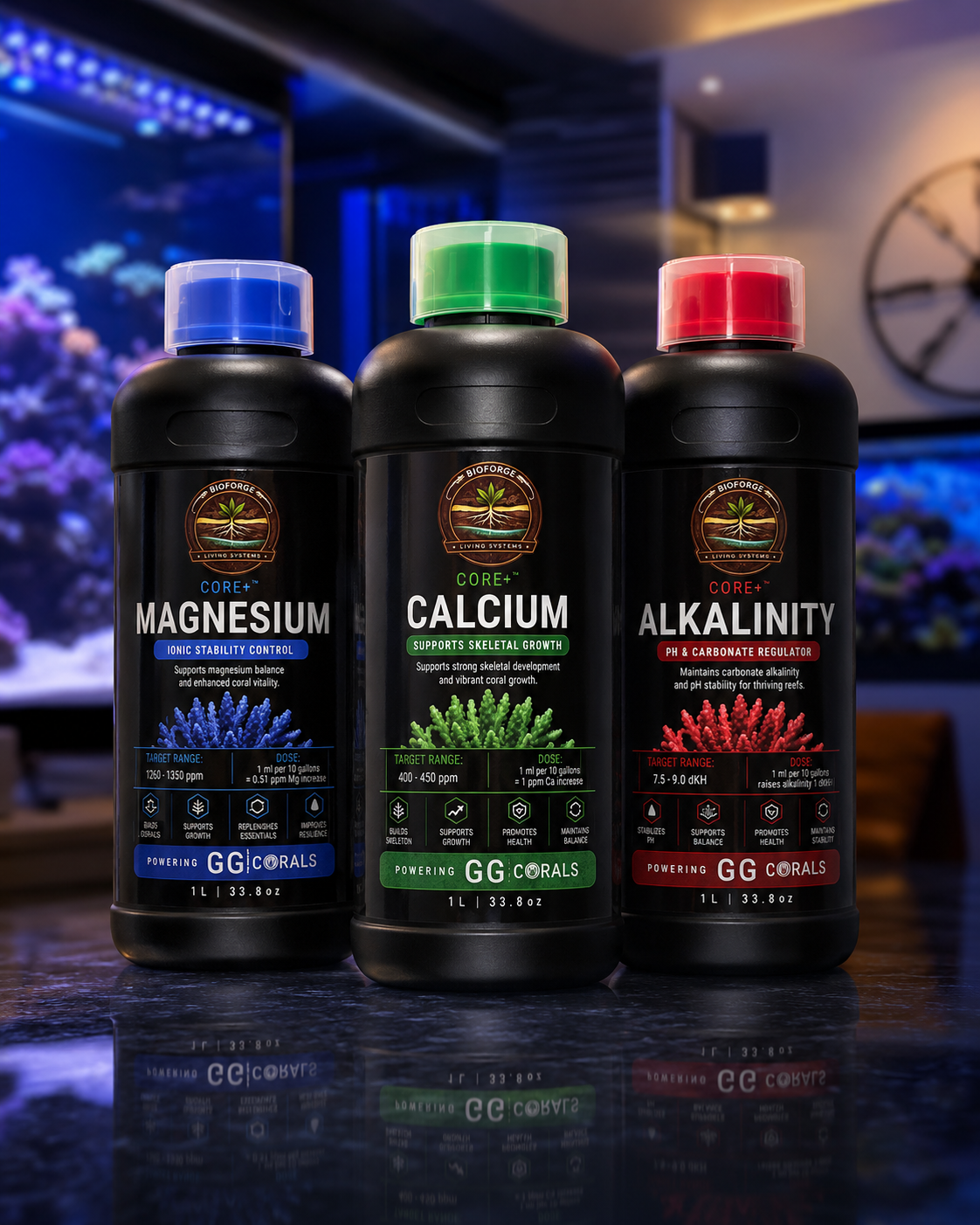
Pick up almost any reef supplement and you'll find a version of the same sentence: dose this much, in this many gallons, to reach this number. It reads like a law of nature. Measure, pour, done. And for a lot of new reefers it becomes the whole mental model of dosing, a fixed recipe that should hold the tank steady forever.
The trouble isn't the chemistry on the label. It's the quiet second claim riding underneath it, and it's a habit the whole category leans on rather than any one brand: the idea that a single dose number can both raise a parameter and maintain it. Those are two different questions, and only the first one has a fixed answer.
This isn't a takedown of supplements or of dosing math. It's a look at where a comfortable shortcut stops being true, and why the tank in front of you always gets the last word.
The three things worth understanding
- The raise math is real and testable. How much of a given solution lifts alkalinity or calcium by a set amount in a set volume is fixed stoichiometry. That part of the label is usually close.
- The maintenance dose is not a constant. To hold a level, you have to replace exactly what your tank consumes each day, and that consumption is driven by what's alive and growing in it, not by the water volume alone.
- Consumption is a moving target. Demand climbs as coral grows, shifts with the alkalinity level you keep, and even changes with what precipitates on your equipment. A number that fit last quarter usually doesn't fit today.
What the label actually gets right
Start by giving the bottle its due. The reaction chemistry behind two-part and powdered dosing is well understood and genuinely fixed. Corals lay down calcium and carbonate in a 1:1 molar ratio, which means alkalinity and calcium are consumed together in a predictable stoichiometry: roughly every 1 meq/L of alkalinity used corresponds to about 20 ppm of calcium used, which works out to around 2.8 dKH per 20 ppm in the units most reefers actually read.12
Because those ratios are fixed, a "raise" instruction can be calculated exactly. If a product tells you a certain scoop raises a certain volume by a certain number of dKH, that figure comes straight from the math, and you can verify it with a test kit the same afternoon.2 There's no sleight of hand there. This is the part of dosing that behaves like a recipe.
The problem starts the moment that raise figure gets quietly reused as a maintenance figure, as if the amount that moves your alkalinity up two points on day one is also the amount that will hold it steady on day thirty.
Where the fixed dose quietly breaks
Maintaining a parameter is a different problem from raising it. To hold alkalinity at a target, you have to add back exactly what the tank pulls out each day, no more and no less. That daily figure is your consumption, and consumption isn't a property of the bottle or even of the water volume. It's a property of the living community in the tank.
Demand is set by biomass, not by gallons
A tank packed with fast-calcifying Acropora burns through alkalinity and calcium at a completely different rate than a same-size tank of soft corals and a few LPS, even when both are dialed to identical target numbers. Branching stony corals have been documented growing at meaningfully different rates across species and even across sites within a single species,6 and those growth differences translate directly into different daily draw on your chemistry. Two tanks, one target number, two different maintenance doses. There is no single label figure that can be correct for both.
The community changes the chemistry itself
It goes deeper than headcount. Peer-reviewed work measuring alkalinity and calcium flux found that the ratio of alkalinity uptake to calcium uptake was measurably different for corals in isolation than for the same corals sitting in a mixed community of algae, sediment, and other life.4 The rest of the tank, in other words, isn't a neutral backdrop; sand beds, macroalgae, and microbial life all shift the local chemistry and therefore the demand a dose has to meet. A bottle printed for an idealized "average reef" can't account for any of that.
Even the level you choose moves your demand
Here's the part that surprises people: the alkalinity you decide to hold changes how fast you consume it. Some corals calcify faster at higher alkalinity,5 and abiotic precipitation on heaters and pumps also rises with alkalinity, so a tank kept at 11 dKH generally needs more daily dosing than the same tank kept at 7 dKH.1 Demand isn't just tank-specific, it's setting-specific within the same tank. A fixed maintenance number can't follow a target that moves the demand curve underneath it.
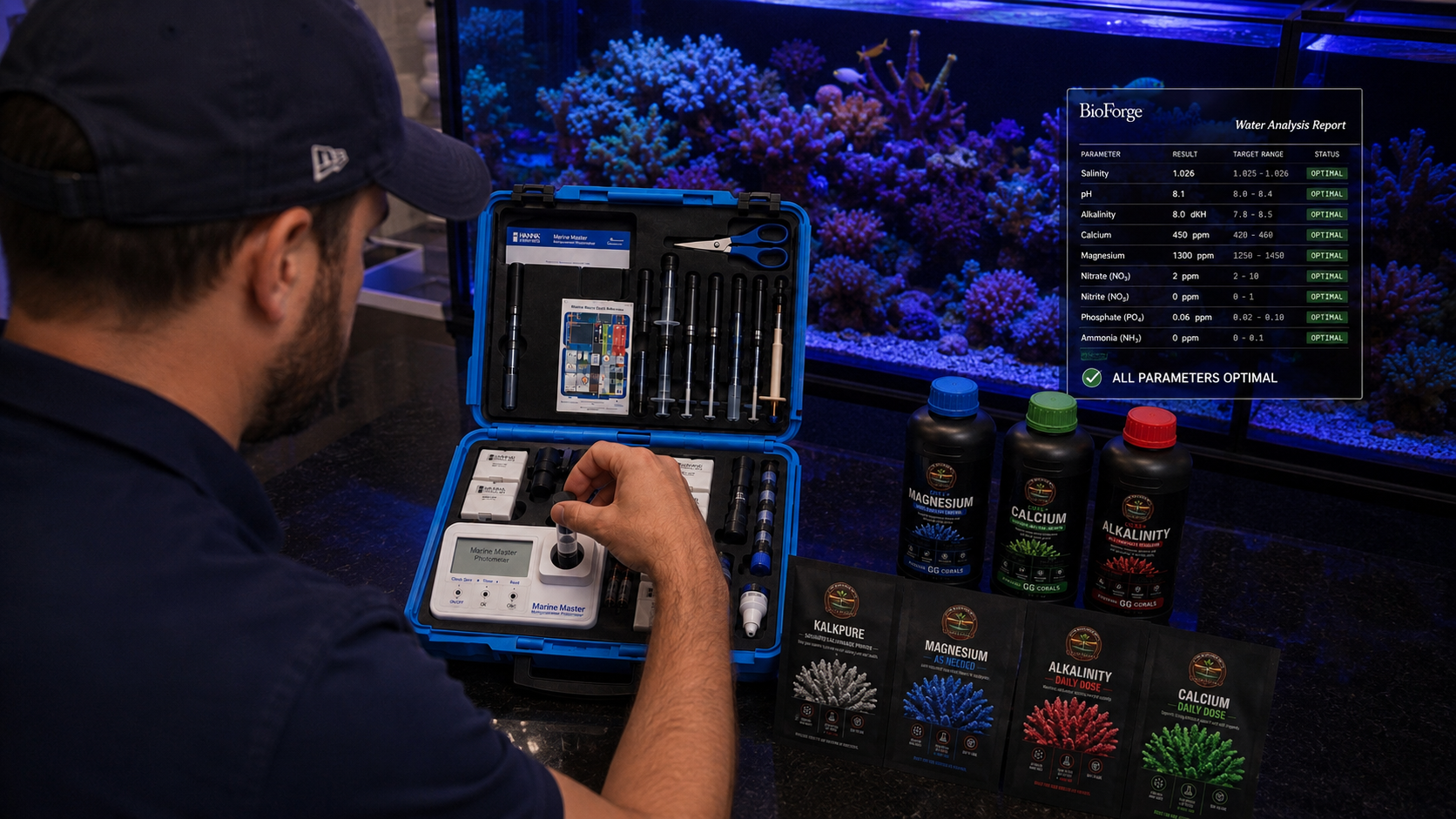
The only figure that reflects your actual demand is the one you measure yourself: how much alkalinity your tank drops in a day. A checker like this, read at the same time for a few days, tells you more than any dose printed on a bottle.
The practice that actually works: measure, then recalibrate
The fix is refreshingly low-tech. Instead of trusting a printed dose to hold your tank, you find your tank's real demand by watching what it does over a few quiet days:
- Measure your consumption first. Test alkalinity at the same time each day for three to five days without changing anything. If it falls from 8.5 to 7.9 dKH in a day, your tank consumed 0.6 dKH that day. That number, not a label figure, is what your dose should replace.3
- Set your dose to that demand. Now the raise math on the bottle becomes useful in the right way: use it to work out how much product replaces your measured 0.6 dKH, and dose in small, frequent amounts rather than one big pour.7
- Recheck as the tank grows. Demand climbs as coral adds mass, so re-measure consumption every so often. A dose that was perfect three months ago is usually running low now.
It's a lesson we picked up early from Charlie, a reefer with far more years in the hobby than we have. His point was blunt and it stuck: every tank is its own system, and a number that keeps one reef perfectly stable can slowly starve or burn another. The bottle can tell you its own recipe. It can't test your water.
| The claim | Is it true? | Why |
|---|---|---|
| "This scoop raises X gallons by Y dKH" | Usually yes | Fixed stoichiometry; you can verify it with a test kit the same day |
| "Dose this daily to maintain Y" | Only by luck | Maintenance equals your consumption, which is set by your livestock, not the label |
| "This dose will keep working" | No | Demand climbs as coral grows and shifts with the level you hold |
| "Your consumption from a measured drop" | Yes, for your tank | It's your tank's own answer, measured directly, and it's the number to dose around |
None of this makes supplements bad or the math dishonest. It makes the fixed-dose habit an oversimplification: a genuinely correct raise figure, stretched to cover a maintenance question it was never able to answer.
What this means for your dosing plan
This is exactly why BioForge Decode hands you a starting dose plus a retest date rather than one number to trust indefinitely. Your plan starts from your actual ICP results, tank profile, and livestock, so it's an informed starting point instead of a generic figure. From there the work is the same loop every serious reefer runs: measure what your tank consumes, dose to that, and recalibrate as the tank grows. The variability is real. Building your dosing around it, instead of pretending a label already solved it, is the whole game.
FAQ
Is the dosing amount on a supplement label wrong?
Not the part that raises a parameter. The math for how much solution lifts alkalinity or calcium by a given amount in a given volume is real, testable stoichiometry and is usually close. What doesn't hold is the leap from that raise figure to a fixed daily dose that supposedly maintains a level. Maintenance dose equals your tank's daily consumption, and consumption is driven by living biomass no bottle can measure.
Why does the same daily dose hold one tank but not another?
Daily consumption of alkalinity and calcium is set by what's actually calcifying in the tank: coral species mix, biomass, growth rate, and even the alkalinity level you choose to hold. Two tanks of the same size with the same target numbers can consume very different amounts per day, so a single fixed dose will drift one of them up or down over time.
How do I find the right dose for my own tank?
Measure your consumption. Test alkalinity at the same time each day for three to five days without changing anything, and see how much it falls per day. That daily drop is your tank's real demand, and it's the number a dose should be built around, not a generic figure from a label or a forum chart.
Does consumption stay the same once I dial it in?
No. As coral grows, demand climbs, so a dose that was perfect three months ago is usually low today. Consumption also shifts with the alkalinity level you maintain and with abiotic precipitation on heaters and pumps. This is why dosing is a loop of measure and recalibrate rather than a number you set once.
How does BioForge handle this differently?
Decode builds a starting dose from your ICP results, tank profile, and livestock, then sets a retest date instead of presenting one dose as a permanent answer. The point is to give you an informed starting point and a habit of recalibrating against your own tank, because your tank's demand always has the final say.
Sources & further reading
Every factual claim in this article is sourced from peer-reviewed research, established reef husbandry publications, or reef chemistry references. If you want to verify anything yourself, here are the primary references:
SEE YOUR OWN NUMBERS
Get a dose built from your tank's actual data.
Submit your ICP results, tank profile, and photos, and get a starting dose with a built-in retest date, tuned to what your tank actually consumes. $39, no subscription required.