REEF SCIENCE · COMPARISON
Hanna vs Salifert alkalinity: which one do you trust?
Same water, two tests, two different numbers. Before you decide one of them is lying, it helps to know what each one is actually measuring, and why a steady disagreement is the most normal thing in reef chemistry.
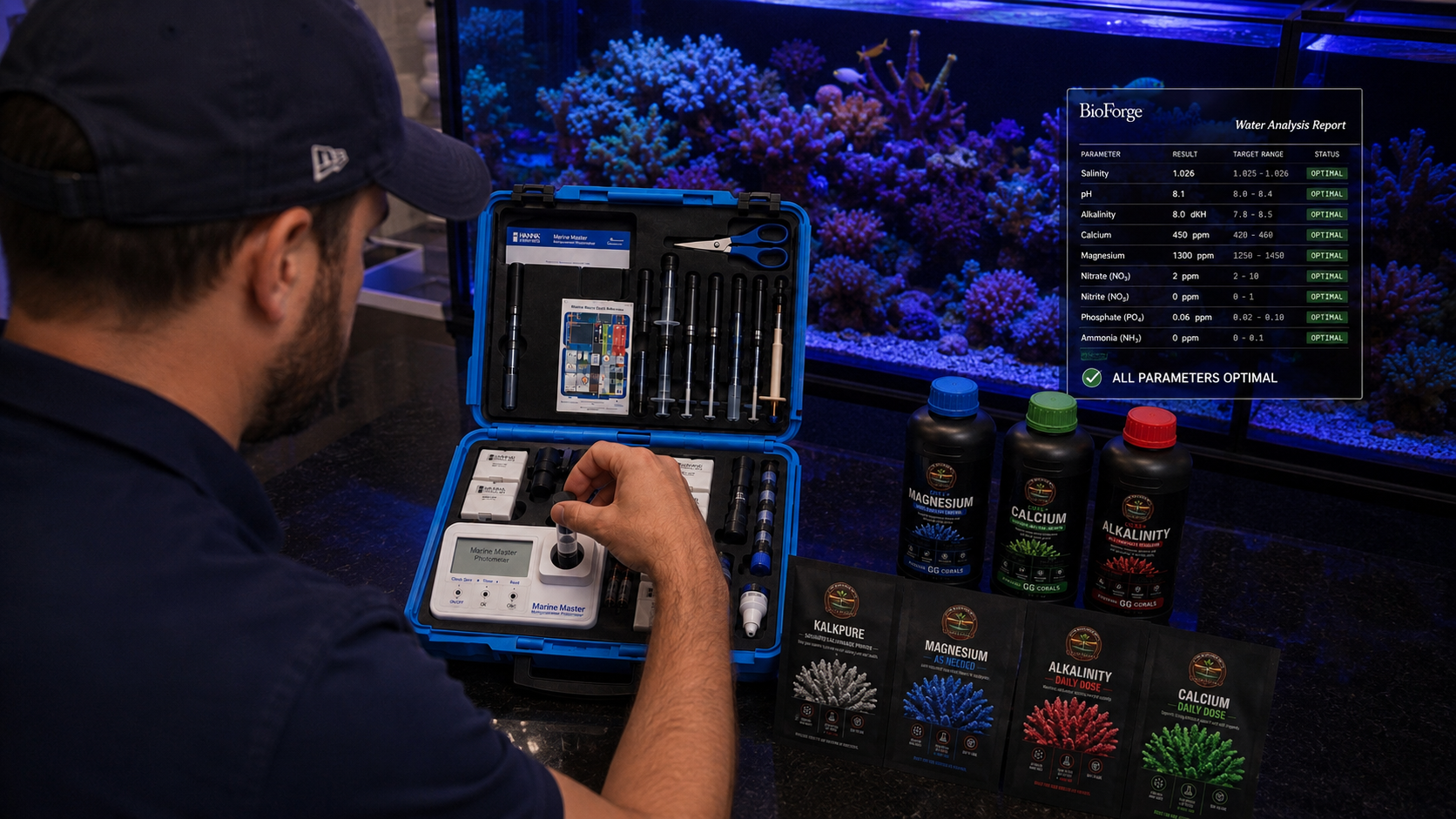
It usually starts the same way. You test with your Salifert kit and get 8.6. Something feels off, so you run the Hanna checker as a second opinion and it says 8.2. Now you have two numbers, one tank, and a new hobby: arguing with yourself about which test to believe. The forums are full of this exact fight, thread after thread of people testing the same cup of water twice and getting two answers.5
Quick disclosure so you know where I stand: I run BioForge, and our Decode service reads ICP results, which is a different tool from either of these kits. I don't sell alkalinity tests and I use both of these brands on my own systems. So this isn't a sales pitch for a side. It's the explanation I wish someone had given me before I wasted a month chasing a 0.4 dKH ghost.
The three things worth understanding
- They measure differently, so they disagree honestly. Hanna reads light absorption through a dyed sample. Salifert counts drops of acid to a color change. Different methods carry different offsets.
- Precision and accuracy are two separate promises. A test can give you the same wrong number every time, or a scattered cloud around the right one. For dosing decisions, the first is more useful than it sounds.
- Consistency beats correctness. Your dosing runs on change over time, not on the absolute number. One test, one routine, one trend line.
What each test is actually doing
The Hanna HI772 checker is a small colorimeter. You add a reagent to your sample, the water changes color in proportion to its alkalinity, and an LED shines light at 610 nm through the cuvette while a silicon photocell measures how much gets absorbed. The electronics convert that absorption into a dKH reading with 0.1 dKH resolution.1 No color judgment by eye, no counting drops. That's the whole pitch: it removes you from the measurement.
Salifert is a classic acid titration. You add an indicator, then add acid from a syringe drop by drop until the sample flips color, and the amount of acid consumed tells you the alkalinity. This is a miniature version of how alkalinity is defined in the first place: the ocean chemistry reference method is also an acid titration, run on lab hardware with a piston burette and a full titration curve instead of a single color flip.3 Salifert is closer in spirit to the real thing. It just swaps a $10,000 titrator for your eyeball.
And that swap is where the disagreement is born. A colorimeter has calibration and reagent-lot offsets. A visual titration has endpoint judgment, syringe reading, and lighting in your fish room. Neither error is large. They're just different, and they don't cancel.
What the numbers say when people test both
Hobbyists have run this comparison to death, and the pattern is remarkably stable. Side-by-side runs on the same water typically land the two tests 0.3 to 0.5 dKH apart, and the direction of the gap is consistent for a given pair of devices and reagent lots: some setups read Hanna high, others read Salifert high, but each pairing tends to hold its own offset from week to week.56
Repeatability is where they separate. Test the same sample five times and the Hanna checker typically scatters about 0.1 dKH around its own average, while Salifert scatters closer to 0.2 dKH.6 That makes Hanna the more precise instrument in most hands. But precise is not the same as accurate: Hanna's own published spec is plus or minus 0.3 dKH plus 5 percent of the reading, which at 8 dKH means the true value can legally sit anywhere in a window about 1.4 dKH wide.1
Sit with that for a second. The gap that's been bothering you is smaller than the error window both manufacturers openly publish. Your two tests aren't fighting. They're agreeing, within spec, and you've been reading the disagreement as a malfunction because nobody puts the error bars on the front of the box.
For scale: the reference-grade titration systems used in ocean carbon chemistry, calibrated against certified reference materials, achieve reproducibility around 2 to 4 micromoles per kilogram, which is roughly 0.006 to 0.011 dKH.34 That's the ceiling. Both hobby kits live about 30 times looser than that, and for keeping coral alive, that's fine.
So which one should you run your tank on?
Here's the part the versus framing gets wrong: your dosing doesn't need the true alkalinity. It needs the change in alkalinity. Whether your tank sits at a true 8.2 or a true 8.6 matters far less than whether it fell 0.7 overnight. Trend detection is a precision job, not an accuracy job, and that reframes the whole choice.2
Pick Hanna if
You test often and you want the smallest test-to-test scatter, or multiple people test the tank and you want the eyeball out of the loop. The checker's 0.1 dKH repeatability makes small trends visible sooner.6 Keep the cuvette clean and fingerprint-free, use the same orientation each read, and expect small shifts when you open a new reagent lot.
Pick Salifert if
You want a direct titration, no batteries, and a lower cost per test, and you're consistent about reading the syringe and judging the endpoint in the same light. Some Salifert kits ship with a reference fluid you can use to sanity-check your technique, which is a quiet advantage: labs keep their titrators honest with certified reference materials, and a known-value check is the home version of the same discipline.4
What you shouldn't do is alternate. Run Hanna on Monday and Salifert on Thursday and their built-in offset shows up in your log as a 0.4 dKH swing that never happened in the water. I've watched people chase that phantom with dosing changes, which then creates a real swing. One test. Same time of day. Write it down. This is the same logic as sticking with one ICP lab, which I've written about in the ICP test comparison: consistency is the instrument.
Further watching
Common questions, answered plainly
Why do my Hanna and Salifert readings disagree?
Different methods, different built-in offsets. Hanna reads light absorption through a dyed sample at 610 nm; Salifert titrates acid to a visual endpoint. A steady 0.3 to 0.5 dKH gap between them is documented across many hobbyist comparisons and doesn't mean either device is faulty.
Is the Hanna checker more accurate than Salifert?
More repeatable, usually: about 0.1 dKH of scatter versus about 0.2 for Salifert in side-by-side runs. But Hanna's published accuracy is plus or minus 0.3 dKH plus 5 percent of reading, so neither tool guarantees the true number. For dosing, repeatability is the trait that earns its keep.
Which test should I actually use?
Whichever one you'll run consistently. Pick one, test at the same time of day with the same technique, and treat its trend as the truth for your tank. Alternating between two offset tests writes phantom swings into your log.
Can I verify my test against a known standard?
Yes, and you should, once. Run a certified reference solution or the included calibration fluid and note how far off your kit lands. That's your personal offset. Labs do the same thing with certified reference materials; you're just doing the pocket version.
Does ICP testing make home alkalinity tests unnecessary?
No. Alkalinity moves daily and a mailed sample is old news by the time a lab reads it. ICP is for the forty-odd elements you can't test at home. Alkalinity belongs to your weekly home test, and the two work best read together.
Sources & further reading
WHERE BIOFORGE FITS
Your home test tracks the trend. Decode reads everything else.
Alkalinity is the parameter you watch weekly. The other forty elements on an ICP report are where problems hide, and Decode turns those results into a dosing plan built for your tank, with a retest date instead of a guess. $39, no subscription, as of August 2026.