REEF SCIENCE · GUIDE
Your ICP results are back. Here's the order of operations.
Five elements flagged, three products in your cart, and a strong urge to fix everything tonight. Slow down. The sequence you correct things in matters more than the corrections themselves, and rushing it wrecks more tanks than it saves.
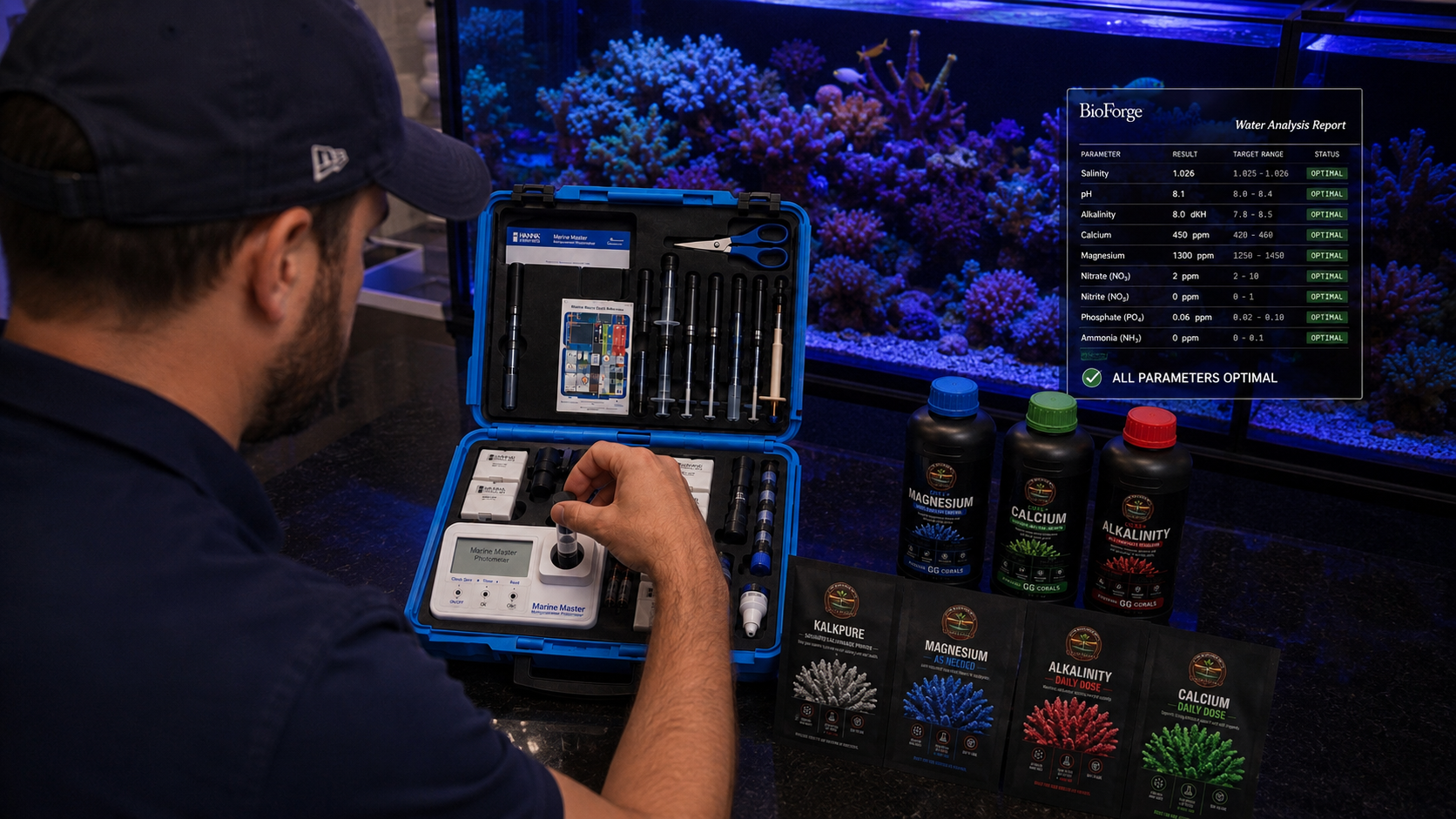
The most common ICP question on every reef forum isn't about any single element. It's some version of "my results are back, five things are out of range, what do I fix first?" And the most common mistake is the honest one: treating the report like a checklist and correcting all five by the weekend. A tank that took months to drift out of range does not need to be dragged back in a week, and it will punish you for trying.
If you haven't read your report yet, start with the companion piece on how to read ICP results from any lab. This article picks up where that one ends: you understand what the numbers say, and now you need a sequence for acting on them.
The three things worth understanding
- Corrections have prerequisites. A trace element dose into a tank with swinging alkalinity is wasted at best. Contamination makes every other reading suspect. The sequence exists because later steps only mean something once the earlier ones hold.
- Your next test is part of this test. An ICP report is one frame of a film. Its real value shows up when the next one confirms your corrections moved things the right direction, and that only works if you changed few enough variables to read the difference.3
- Stability beats correctness. Decades of reef chemistry writing converge on the same point: corals tolerate a wide band of absolute values and punish rapid movement between them.1 The peer-reviewed literature agrees from the other direction: surveys of wild reefs find the same coral species growing at wildly different rates across sites with different water chemistry, which is hard to square with the idea that there's one magic number to hit.7 A tank held steady slightly out of range outperforms a tank yanked violently into it.
First: rule out the two things that invalidate everything else
Contamination
Before any dosing decision, scan copper, aluminium, tin, lead, and the rest of the metals block. Elevated metals are the one genuine emergency an ICP catches that nothing on your test shelf can see, and they demand a source hunt, not a dose: a corroding pump shaft, a metal hose clamp above the sump, rock from a system that ran copper medication, or your RO/DI membrane letting things through.2 If your report includes a source-water analysis, compare it against the tank result before blaming anything inside the glass.
Dosing anything into a contaminated system is redecorating a house that's on fire. Handle this first, alone, and consider a retest before staging other corrections.
Salinity
Every bulk ion scales with salinity. At 33 PSU instead of 35, your calcium, magnesium, and potassium all read proportionally low, and "correcting" them individually bakes the salinity error into your dosing. If salinity is off, correct it slowly over days, and treat every major-element reading on the report as provisional until it's back where it belongs.
Week one: alkalinity, then calcium and magnesium
Alkalinity gets fixed first and gets fixed alone. It's the parameter corals experience most acutely, the one that moves fastest, and the one whose instability makes every other correction pointless.14 This isn't just hobby lore: peer-reviewed reef research shows carbonate chemistry is the axis of water chemistry that varies most on a living reef and the one calcifying corals respond to most directly.5 The correction itself should be gentle: move no faster than about 0.5 dKH per day, and prioritize getting your daily dose matched to daily consumption over hitting the target number quickly. The target is stability at a value, not the value itself.
Calcium and magnesium ride along in the same phase, with one ordering rule worth knowing: if magnesium is low, correct it before fighting with calcium and alkalinity, because low magnesium is often the reason calcium and alkalinity won't hold in the first place.4 Magnesium is the classic hidden variable behind "I keep dosing and it keeps dropping."
Spend the rest of the week confirming the hold with your hobby kits. Alkalinity checked two or three times over a week tells you whether your dose matches your demand. That confirmation, boring as it is, is the foundation every later step stands on.
Week two: nutrients
With the big three holding, look at nitrate and phosphate. The extremes are what matter: a tank stripped to zero on both is starving its corals no matter how perfect the trace elements look, and a tank climbing month over month has an import/export imbalance that no bottle fixes. Adjust feeding, export, or both, and adjust them like you adjusted alkalinity: one change, then observe.
This step earns its place ahead of trace elements for a simple reason. Pale, browned-out, or sulking corals are explained by nutrient extremes and alkalinity instability far more often than by any single trace deficiency, and nutrient corrections are cheap, reversible, and visible within weeks. Exhaust the likely explanation before shopping for the exotic one.
Weeks three and four: trace elements, one or two, no more
Now, and only now, the long tail of the report gets its turn. Pick the one or two trace elements that are furthest out of range or best connected to a symptom you can actually see, and correct those. Follow the dosing product's schedule, size the correction conservatively, and leave everything else alone this cycle.3
The restraint isn't timidity. It's experimental design. Two changes against a stable baseline can be read on the next report. Six changes can't, and stacked trace corrections can interact with each other in ways nobody's report accounts for. The reefers whose tanks improve test over test are almost always the ones making the fewest moves per cycle.
A note on what to skip entirely: readings barely outside the range, elements with no symptom attached, and anything your lab flags at its detection limit. Analytical chemistry work on seawater confirms the humility is warranted: matrix effects and calibration choices measurably shift ICP readings near the bottom of the instrument's range.6 A slightly-low number on an element your corals consume slowly is a "watch next test" item, not a correction.3
Day 30: retest, and read the delta
The retest is not optional. It's the second half of the first test. Around 30 days after your corrections, same lab, same sampling routine, ideally the same time of day. Same lab matters more than most people think: published seawater analysis work shows that calibration and matrix handling differ enough between instruments that switching labs mid-experiment adds noise you can't separate from your corrections.6 If you're still deciding which lab to commit to, the ICP test comparison covers the four big ones. What you're reading this time isn't the absolute values. It's the deltas: did the things you corrected move the way you intended, did the things you left alone hold still, and did anything drift that you didn't touch. That third category is your tank's real consumption showing itself, and it's the most valuable data an ICP can give you.
Retest earlier if livestock tells you to. Polyp extension collapsing, color shifting, growth stalling: the animals report faster than the lab does. Trust them.
The whole sequence on one screen
Contaminants and salinity immediately, alone. Alkalinity to stable, calcium and magnesium alongside, magnesium first if it's low. Nutrients off their extremes. Then one or two trace elements, chosen by distance out of range and visible symptoms. Retest at 30 days and read the deltas. At no point do you correct more than two or three things at once, and at every point the question is "is this holding" before "what's next."
This is also exactly the shape of plan Decode writes, because it's the shape that works. It reads your results from any lab, weighs them against your tank profile, livestock, and photos, and hands back the prioritized sequence with the reasoning shown: fix now, stage for later, leave alone, retest date. If you'd rather not build the sequence yourself, that's the $39 shortcut.
Further watching
Worth your time if you want the video version of this territory:
FAQ
My ICP report flagged five or six elements. Which do I fix first?
Contaminants and salinity first, because everything else is unreliable until they're handled. Then alkalinity, calcium, and magnesium, in that order of attention. Then nitrate and phosphate. Trace elements come last, one or two at a time, only after the foundation is stable.
Why shouldn't I correct everything at once?
Because your next test can't tell you which correction did what. Six simultaneous changes turn a precise instrument into an uninterpretable one, and stacked corrections can interact: raising alkalinity and dosing traces into a swinging system multiplies risk instead of fixing anything.
How long should I wait before retesting?
Around 30 days is a reasonable default for a full ICP retest, with weekly hobby-kit checks on alkalinity in between. Retest sooner if livestock behavior changes noticeably, and later corrections restart the clock.
Do trace element corrections actually fix coral problems?
Rarely on their own. Most visible coral problems trace back to unstable alkalinity, nutrient extremes, or contamination. Trace corrections are refinement for a stable tank, not rescue for an unstable one.
Can Decode build this sequence for me?
Yes, that's what it is. Decode reads your ICP results from any lab plus your tank profile and returns one prioritized written plan: what to fix now, what to stage for later, what to leave alone, and when to retest. $39, no subscription.
Sources & further reading
Every factual claim in this article is sourced from established reef chemistry writing, husbandry publications, and peer-reviewed marine science. If you want to verify anything yourself, here are the primary references:
SKIP THE GUESSWORK
Get the order of operations written for your tank.
Submit your ICP results from any lab, plus your tank profile and photos, and get one prioritized written plan with a built-in retest date. $39, no subscription required.